


Research security applies to every aspect of academic life, including topics like:
- I'm traveling internationally. Who should I contact?
- I'm going on sabbatical. What do I need to know?
- Someone asked me to join their talent recruitment program. Can I?
- How do I know if my research data is secure?
- I need to take research security training. Where is it?
Select the categories below that are relevant to you.
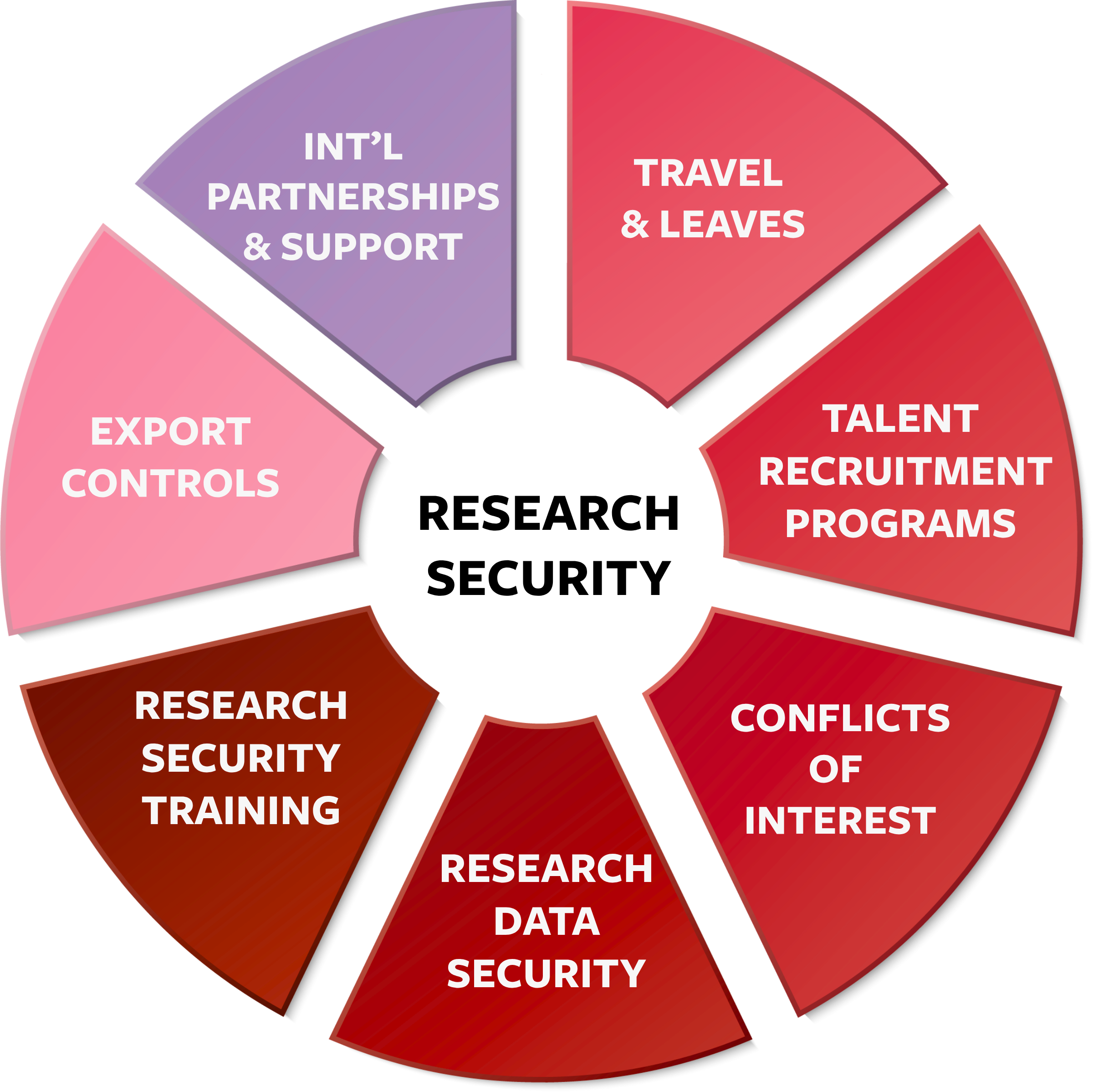 |
International Partnerships & Support
When you are exploring or working with international partners, we provide guidance for:
- Sponsor disclosure requirements (NIH, NSF, and NASA)
- Finding contacts for exploring academic collaborations (Memorandums of Understanding, etc.)
- Where to report foreign gifts and contracts
- How to screen and monitor international visitors.
Cornell's Commitment to International Collaboration
It's important to remember that foreign nationals who are part of the Cornell community as faculty, staff, students, and postdocs are not the target of any of these changing regulations. NSPM-33 guidance includes many "shoulds" but there is one important "must":
"It is essential that the policies and consequences must be applied without discrimination in any way, including with respect to national origin or identity.”
| Resource | Use This To |
|---|---|
| nasa: affiliations w/ china and disclosing current & pending support |
|
| engagement w/ china: guidelines & FAQ |
|
| NSF information for proposals w/ int'l collaborators |
|
| exploring an academic collaboration |
|
| international contracting basics |
|
| reporting foreign gifts and contracts |
|
| hiring for international work |
|
| export controls in research & education – visiting scholars |
|
Travel & Leaves
When you travel internationally, you need to:
- Let Cornell know where you are in advance to find you in case of emergencies
- Travel safely with your technology
- Keep your devices secure
- Ensure you won't be stopped at borders with illegal exports.
Learn about the different types of available leaves, and who to contact.
Note: Always let your manager and colleagues know about travel and leaves in advance.
| Resource | Use This To |
|---|---|
| international travel registry guide |
|
| traveling with technology |
|
| high risk travel loaner program |
|
| digital privacy and data searches at u.s. borders |
|
| export controls and international travel |
|
| leaves |
|
Talent Recruitment Programs
The Creating Helpful Incentives to Produce Semiconductors (CHIPS) and Science Act of 2022 prohibits federal employees, contractors, and awardees—including institutions, individual investigators, and other key personnel —from participating in Malign Foreign Government Talent Recruitment Programs.
| Resource | Use This To |
|---|---|
| malign foreign talent recruitment programs |
Note: Participation in these programs by any Cornell employee or researcher is strictly prohibited. |
Conflicts of Interest
Everyone required to complete a Conflict of Interest (COI) report will receive an email directing them to do so.
| Resource | Use This To |
|---|---|
| conflicts of interest |
|
Research Security Training
Learn how to take research security training, which satisfies requirements for the National Science Foundation, the U.S. Department of Energy, the United States Department of Agriculture, the National Institutes of Health, NIH Other Support Disclosure (OSD) training, the National Aeronautics and Space Administration, and the institutional requirements set forth in National Security Presidential Memorandum 33 (NSPM-33).
Note: Federal sponsors require research security training for all researchers.
For NSF and NIH: Cornell will be unable to submit a proposal until all PIs, Co-PIs, and key personnel on the proposal have completed CU601.
| Resource | Use This To |
|---|---|
| Cu601: research security |
|
Research Security Data
Learn how to manage and secure your research data and make data management plans.
| Resource | Use This To |
|---|---|
| Department of Justice (DOJ) bulk data rule |
Note: Civil and criminal penalties may be imposed by the DOJ for violations of the Bulk Data Rule. |
| data management & sharing plan (DMSP) |
|
| research data storage finder tool |
|
| CERTIFIED DESKTOP IT SERVICE |
|
Export Controls
Learn how to manage export controls for research and education.
Note: Penalties for non-compliance with export control laws are severe and impact both the institution and the researcher. If an export control violation is determined by an investigating agency, an individual may be subject to civil and criminal penalties, and Cornell may be subject to, among other penalties, debarment from government contracts.
| Resource | Use This To |
|---|---|
| export controls |
|
| export controls in research & education |
|
| export control and confidentiality agreements |
|
| export controls FAQs |
|
How does Cornell partner with researchers to address federal requirements?
- Strives to be proactive—smooths the way for effective compliance.
- Actively monitors regulations. Consults with peers. Engages with professional associations.
- Collaborates internally across offices and areas of expertise (OVPIA, OVPRI, OSP, CTL, ORIA…)
- Improves Cornell policies as required and provides guidance on the Research Services website.
- Collects information from researchers using central systems to reduce burden as much as possible. (Conflict of Interest; RASS; etc.)
- Screens entities against restricted party lists.
- Alerts from RASS for sponsored projects (e.g., if a project involves an entity located in a foreign country of concern).
Contact
Questions? Contact your Research Security Officer.
Related Policies
Cornell has created a suite of policies to help you manage and secure your research:
Research Data Security Policies
| Policy | Category | Helps Me |
|---|---|---|
| Information Security | IT Security | Properly collect, store, disclose, access, process, destroy, and classify information |
| Responsible Use of IT Resources | IT Security | Avoid and report fraud |
| Authentication to IT Resources | IT Security | Make good passwords |
| Physical Security Systems | Physical Security | Secure my labs/office |
| Data Stewardship & Custodianship | Data Security | Secure my data |
| Reporting Electronic Security Incidents | Data Security | Report data loss/malware |
Research Security Policies
| Policy | Category | Helps Me |
|---|---|---|
| Research Data Retention | Data Retention | Learn my responsibilities for collecting and retaining data |
| Research Related Conflict of Interest & Commitment | Conflict of Interest, Conflict of Commitment | Decide whether I have a research-related Conflict of Interest or Conflict of Commitment |
| Non-Research Conflict of Interest & Commitment | Conflict of Interest, Conflict of Commitment | Decide whether I have a non-research-related Conflict of Interest or Conflict of Commitment |
| Reference Checks, Info Verification, & Background Checks | Checks & Verification | Conduct thorough reference checks and detailed information verification on all applicants (external and internal) to whom an offer of employment is to be made |
| Leaves for Professors & Academic Staff | Leave | Take leave from appointed responsibilities under certain circumstances |
| Time Off & Leaves | Leave | Learn types of leaves, what to do before I go on leave |
| University Volunteers | Volunteers | Reduce volunteer risk and protect the interests of the university, its volunteers, and the community it serves |
| Standards of Ethical Conduct | Ethics | Learn Cornell's ethical standards |
| Export & Import Control Compliance | Export/Import Control | Comply with U.S. Export and Import Control Regulations |
| Risk Management for International Travel | Travel | Learn guidelines for planning international travel; learn resources available to assist me when I am faced with emergencies while traveling internationally on university business |