

Cornell faculty collaborate across disciplines and campuses to solve complex global health challenges facing humanity.
Collaborative projects between researchers on the Ithaca-based campus (Cornell-Ithaca, AgriTech in Geneva, and Cornell Tech in New York City) and the Weill Cornell Medicine (WCM) campus (New York City and Qatar) are set up as “intercampus awards.”
Cornell has established an intercampus administrative process involving each campus’s sponsored research office:
Cornell-Ithaca's Office of Sponsored Programs (OSP)
WCM’s Office of Sponsored Research Administration (OSRA).
In all other respects, an intercampus award is the same as an award that involves collaborators from different units/departments in the same campus.
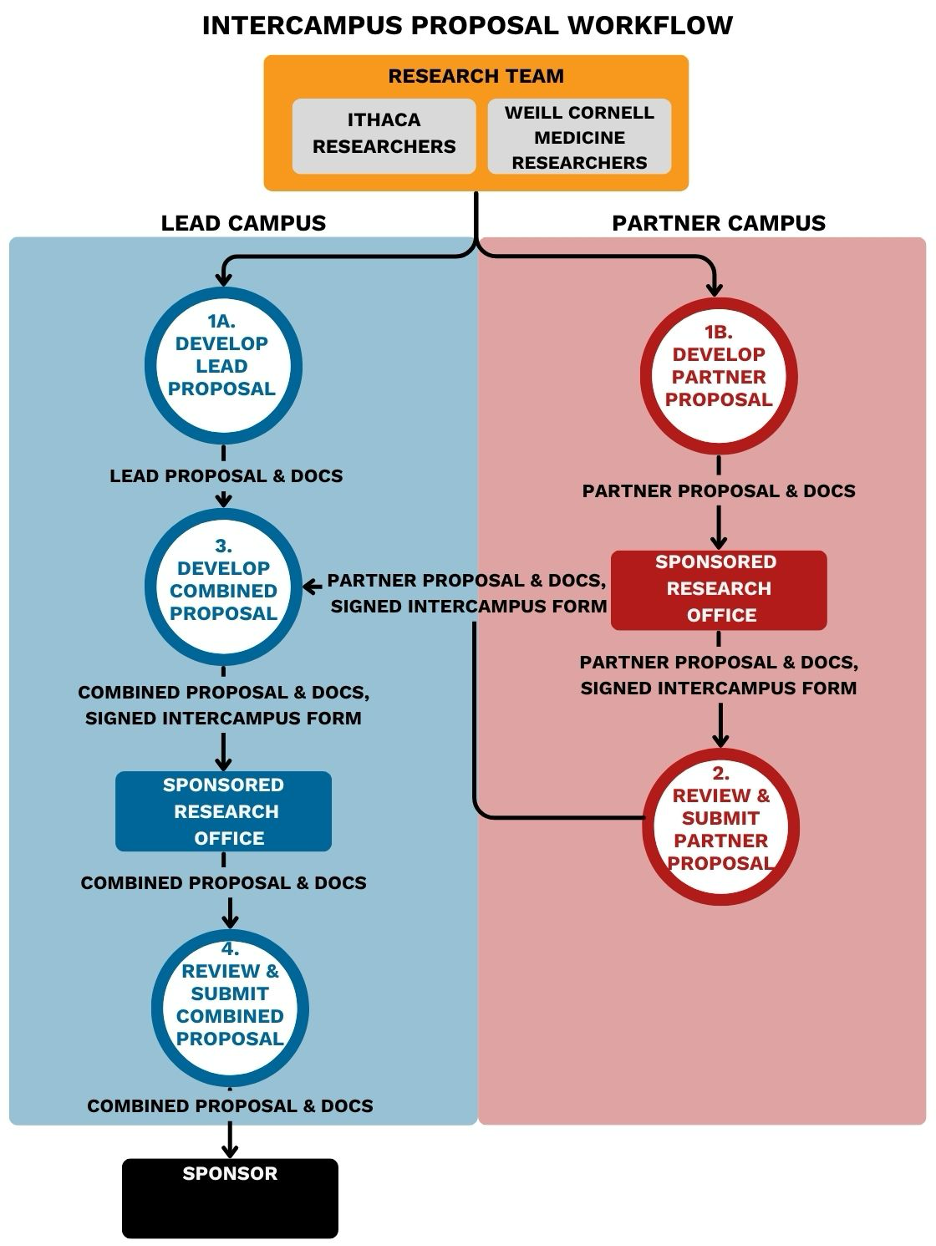
1A. Develop Lead Proposal—The Lead Campus PI/Department develops proposal documents related to the collaborative work, including the scope of work, budget, biosketches, and internal routing forms.
1B. Develop Partner Proposal—The Partner Campus PI/Department develops proposal documents and sends them to their sponsored research office for review.
2. Review & Submit Partner Proposal—The Partner Campus sponsored research office submits the proposal, including the signed Intercampus Application Approval Form, to the Lead Campus PI, copying the Lead Campus’s sponsored research office:
Cornell-Ithaca Office of Sponsored Programs (OSP) contact email
WCM Office of Sponsored Research Administration (OSRA) contact email.
3. Develop Combined Proposal—The Lead Campus PI/Department incorporates the Partner Campus’s budget and research work into a combined proposal and submits the combined proposal and documents to their sponsored research office.
4. Review & Submit Combined Proposal—The Lead Campus sponsored research office reviews the proposal package, confirms the Partner Campus’s sign-off of the Intercampus Application Approval Form, and submits the combined proposal and documents to the Sponsor.
Lead Campus: Ithaca
The following shows the award workflow if Cornell Ithaca is the lead campus:
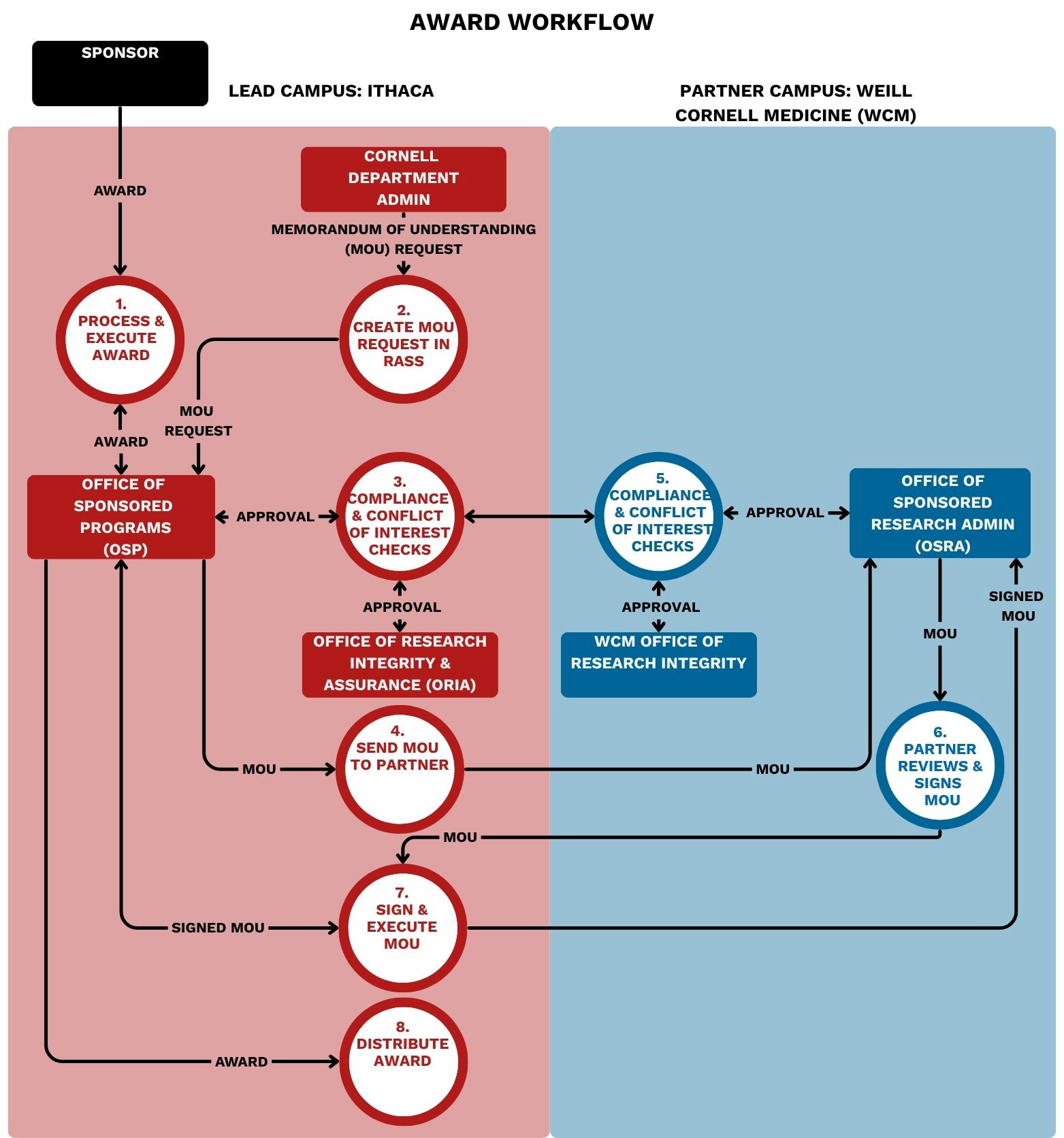
1. Process & Execute Award—When the Sponsor sends the award, the Office of Sponsored Programs (OSP) receives, processes, and executes the award.
2. Create MOU Request in RASS—The Cornell Department administrative unit submits a request to their sponsored programs office to issue a completed and signed Intercampus Memorandum of Understanding (MOU) to the Partner Campus in Research Administration Support System (RASS). RASS contains information about the award's type of work (e.g., if it involves humans, animals, biosafety, conflicts of interest, etc.).
3. Compliance & Conflict of Interest Checks—Depending on the type of work and funding source, compliance checks, congruence checks, and Conflict of Interest (COI) checks may be required. OSP determines the appropriate checks and facilitates further actions.
For projects that require compliance checks, compliance offices on each campus (the Office of Research Integrity and Assurance (ORIA) for Ithaca and the Office of Research Integrity for WCM) work together to finalize authorization agreements and grant protocol congruence as required by regulations. Compliance offices notify their sponsored programs office when complete.
Research involving humans involves the IRB office.
Research involving live vertebrate animals involves the IACUC office.
- For direct or flow-through funded projects involving live vertebrate animals, IACUC issues WCM a partial MOU that outlines who is responsible for animal welfare. IACUC offices in both campuses facilitate compliance checks, and WCM IACUC signs the MOU.
Research involving biosafety involves the IBC office.
4. Send MOU to Partner—When compliance checks are completed, Cornell OSP sends WCM a MOU.
- 5. Partner Compliance & Conflict of Interest Checks—Depending on the type of work and funding source, compliance checks, congruence checks, and Conflict of Interest (COI) checks may be required by the partner campus. WCM Office of Sponsored Research Administration (OSRA) determines the appropriate checks and facilitates further actions.
6. Partner Reviews & Signs MOU— The Partner Campus reviews and signs the Intercampus Memorandum of Understanding (MOU) and sends a copy to the Lead Campus. MOU Terms & Conditions include:
The complete award document from the sponsor, without redactions.
Indication of the total anticipated funds for the entire duration of the award.
Full Facilities and Administrative (F&A) Cost Rates, unless limited by the sponsor.
Automatic carry forward, when allowed by the sponsor.
A scope of work and budget for the Partner Campus.
7. Sign & Execute MOU—Cornell signs and executes the MOU. The award can now be accepted and funds can be released.
8. Distribute Award—The Grant and Contract Officer (GCO) and OSP distributes the award to campuses and Sponsored Financial Services through RASS.
Note: Amendments go through an abbreviated workflow. Cornell sends WCM signed amendments; when WCM signs and returns the amendments, the amended MOUs are considered complete.
Lead Campus: Weill Cornell Medicine (WCM)
The following shows the award workflow if Weill Cornell Medicine (WCM) is the lead campus:
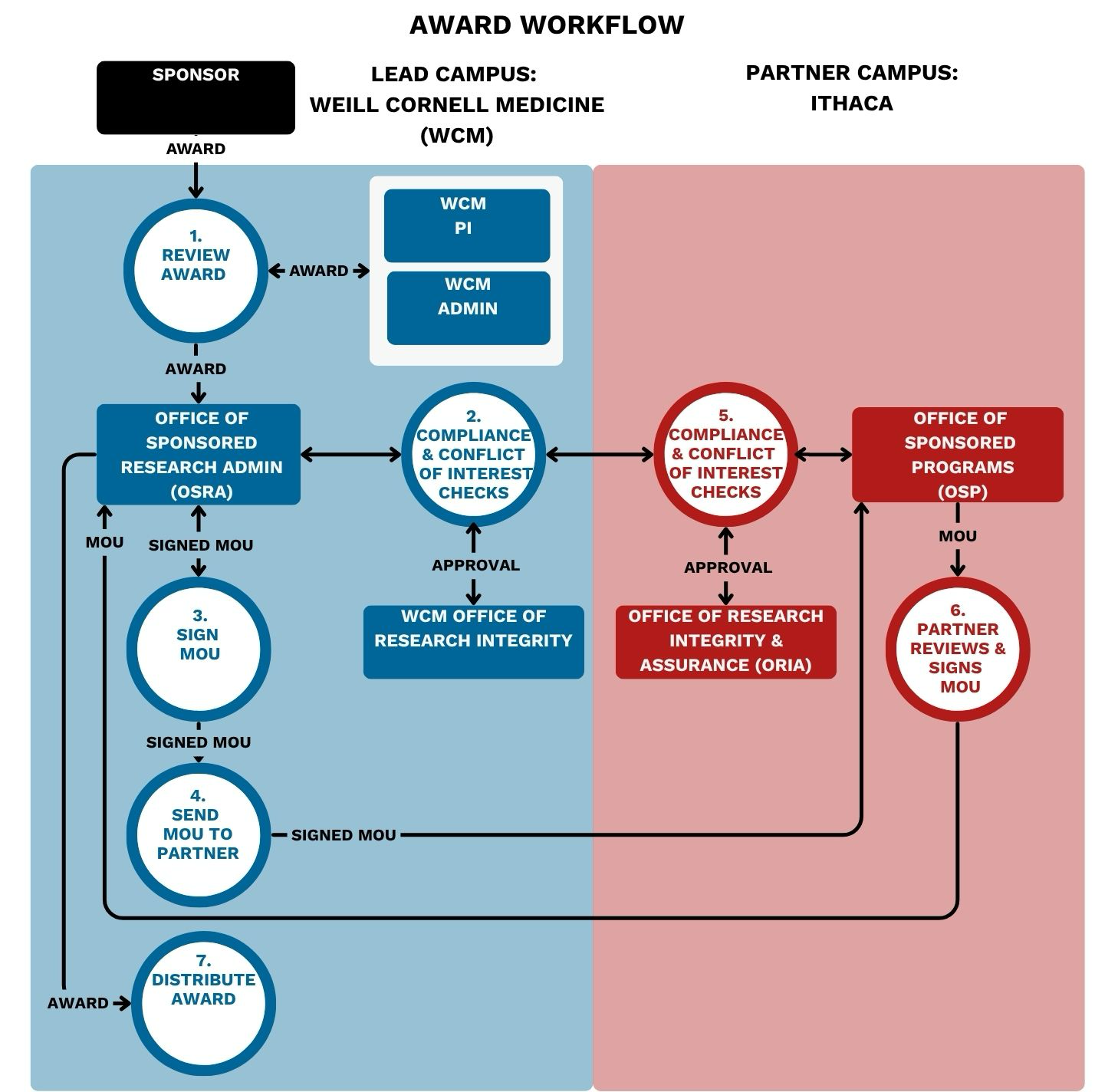
1. Review Award— WCM Administration and the PI receive and review the award from the Sponsor.
2. (WCM) Compliance & Conflict of Interest Checks—Depending on the type of work and funding source, compliance checks, congruence checks, and Conflict of Interest (COI) checks may be required. The WCM Office of Sponsored Research Administration (OSRA) determines the appropriate checks and facilitates further actions through the WCM Office of Research Integrity, collaborating with Ithaca's Office of Research Integrity and Assurance (ORIA) to finalize authorization agreements and grant protocol congruence as required by regulations. Compliance offices notify their sponsored programs office when complete.
3. Sign MOU—WCM OSRA signs a Memorandum of Understanding (MOU).
4. Send MOU to Partner—OSRA sends the signed MOU to Cornell's Office of Sponsored Projects (OSP).
- 5. (Ithaca) Compliance & Conflict of Interest Checks—Depending on the type of work and funding source, compliance checks, congruence checks, and Conflict of Interest (COI) checks may be required. Cornell OSP determines the appropriate checks and facilitates further actions through the Office of Research Integrity and Assurance (ORIA).
- 6. Partner Reviews & Executes MOU—The Partner Campus reviews and executes the Intercampus Memorandum of Understanding (MOU) and sends a fully executed copy to the Lead Campus. MOU Terms & Conditions include:
The complete award document from the sponsor, without redactions.
Indication of the total anticipated funds for the entire duration of the award.
Full Facilities and Administrative (F&A) Cost Rates, unless limited by the sponsor.
Automatic carry forward, when allowed by sponsor.
A scope of work and budget for the Partner Campus.
7. Distribute Award—OSRA distributes the award.
Budget Considerations
Each campus will develop their budget with their applicable Facilities and Administrative (F&A) rates.
The budget submitted to the sponsor is developed with each campus’ expenses rolled-up into the overall budget, using the appropriate campus-specific rates.
Each campus receives its respective F&A.
Since no subcontract is involved, the Lead Campus does not collect F&A on the first $25K of the Partner Campus’s direct costs.
A separate budget should be prepared with the expenses broken down by campus to facilitate campus review and post-award administration.
Invoices
Invoices will be sent to the appropriate offices/contacts identified in the MOU accompanying the award.
Invoices will be sent no less than quarterly and no more than monthly, with final invoices submitted no later than 90 days following the award termination date.
Budget Tips
How should budgets be presented on proposals?
Prior to building a final application budget, each campus’s separate budget should be finalized in Excel for ease of review. It is important that each campus develops a budget employing its own fringe benefit and F&A rates.
Invoice Approval
How do funds move from one campus to the other?
While intercampus awards do not constitute a formal subcontract relationship, each campus finance office will prepare invoices for reimbursement as per the terms of the MOU. Principal Investigators at the Lead Campus remain responsible for the review and approval of all invoices from the Partner Campus.
CTSC Programs
How does the Clinical & Translational Science Center (CTSC) Program differ from other intercampus proposals?
When OSP has reviewed and approved an application, Ithaca campus submits their proposal directly to the CTSC in response to their published Request For Applications (RFAs).
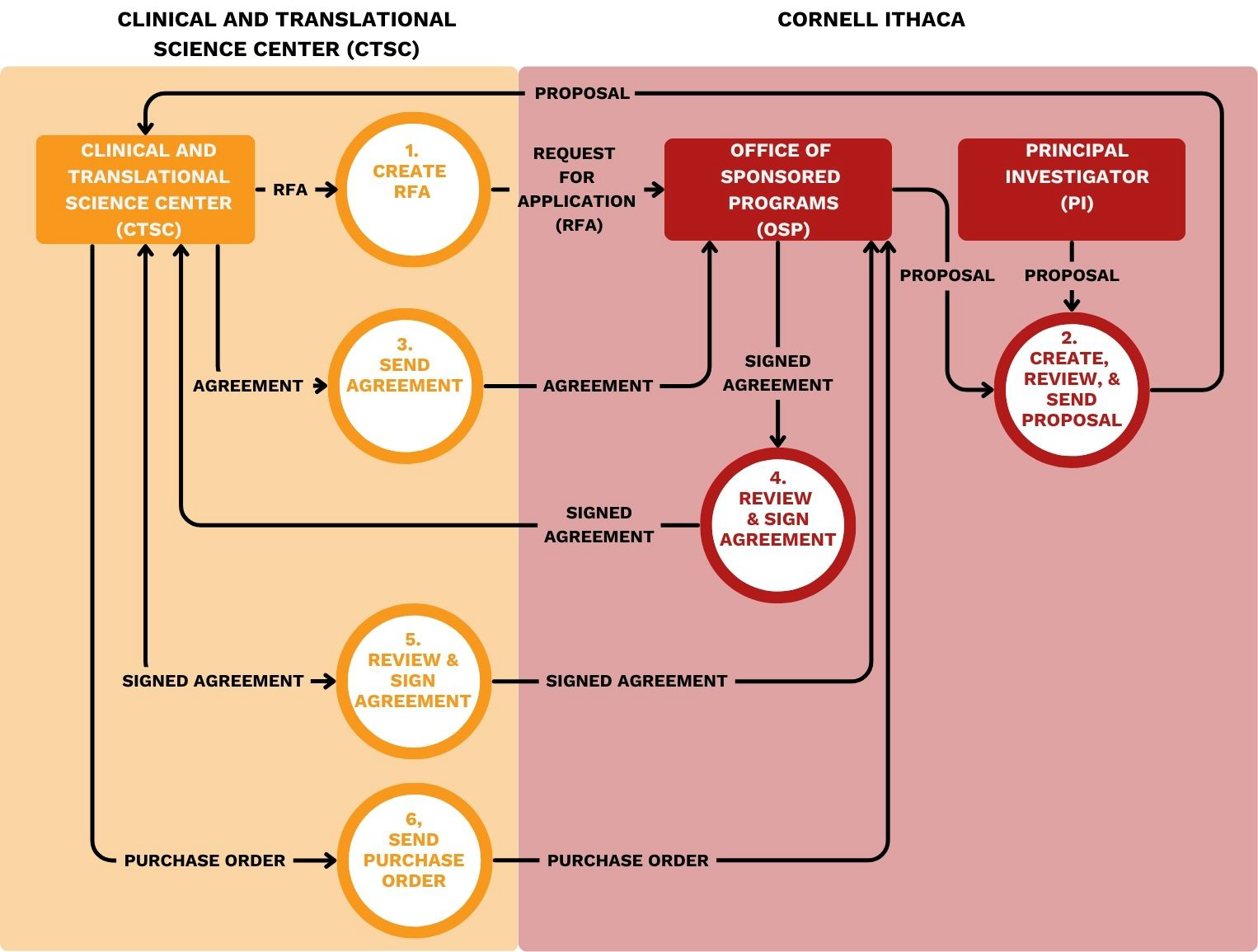
1. Create an RFA–The CTSC creates a Request For Application (RFA).
2. Create, Review, & Send Proposal–The Cornell Principal Investigator (PI) and Office of Sponsored Programs (OSP) create, review, and submit their proposal to the CTSC.
3. Send Agreement–When Cornell is selected for funding, the CTSC sends Cornell an unsigned agreement.
4. (Ithaca) Review & Sign Agreement–The Cornell PI and OSP review and sign the agreement in RASS. OSP sends the signed agreement to CTSC.
5. (CTSC) Review & Sign Agreement–CTSC reviews and signs the agreement and sends Cornell a signed copy.
6. Send Purchase Order–CTSC sends Cornell a purchase order to initiate the award execution.
Internal Funding
When do I have to work through the Central OSRA/OSP Offices for my awards?
When an award has funding coming from an outside entity that is sponsored research, those awards must be routed through Ithaca’s OSP and Weill’s OSRA Offices.
When funding is internal to Cornell and is not coming from an external source (i.e., NIH or another outside entity), those awards do not have to be routed through the OSP/OSRA Offices. In those circumstances, a transfer of funds can be handled as accounting transactions. The Division of Financial Affairs in Ithaca provides information on the transfer of funds process.
Cornell-Ithaca Office of Sponsored Programs (OSP)
Proposal Submission Email: cu_proposals@cornell.edu
Ithaca Partner Campus Contact: Corey Burger, scb255@cornell.edu
Ithaca Lead Campus MOU Contact: Tammy Wildenstein, twl62@cornell.edu
WCM Office of Sponsored Research Administration (OSRA)
Proposal Submission Email: grantsandcontracts@med.cornell.edu
WCM Partner Campus Contact: Latoya Palmer, Grants Manager, lap2015@med.cornell.edu
WCM Partner Campus MOU Contact: Jazmin Kirby, Contracts Manager, jak2055@med.cornell.edu, subawards-wcmc@med.cornell.edu
Compliance
The Cornell Office of Research Integrity and Assurance (ORIA)
- Coordinates compliance measures on campus and acts as a resource for the university community's concerns regarding compliance requirements.
WCM Office of Research Integrity
- Provides oversight, support, and educational training in matters relating to Research Integrity. Partners with the academic and biomedical research community at Weill Cornell Medicine, Weill Cornell Graduate School of Medical Sciences, and its collaborating institutions and organizations.
Institutional Animal Care and Use Committee (IACUC)
Note: Cornell and WCM IACUC are subject to Cornell Policy 1.4.
- Policies and procedures to protect the welfare of vertebrate animals in research, teaching, and testing.
- Policies and procedures to protect the welfare of animals as required by federal regulations and laws.
Institutional Biosafety Committee (IBC)
- Responsible for processing IBC registrations and assisting with compliance with regulatory guidelines involving the use of recombinant or synthetic nucleic acids and/or biosafety.
- Ensures that all research conducted at Weill Cornell Medicine (WCM) complies with applicable Federal, State and local health, safety standards and Institutional policies for biosafety.
Institutional Review Board (IRB) Human Subjects
- Responsible for providing guidance and oversight for Cornell's Human Research Protection Program, and for helping to maintain compliance with applicable regulations and policies.
- Responsible for ensuring that all human subject research activities are conducted ethically and in compliance with Federal regulations, the requirements of applicable New York State and local laws, and institutional policies and procedures.
Note: For more, see: Multi-site and Collaborative IRB Research.
- A collaborative, campus-wide organization that links Cornell University faculty, staff and students with data management services to meet their research needs.
- Services include creation and implementation of data management plans.
- CDS helps researchers find specialized data management services at any stage of the research process, including initial exploration, data gathering, analysis and description, long term preservation and access.
Cornell Center for Social Sciences (CCSS)
- The Cornell Center for Social Sciences accelerates, enhances, and amplifies social sciences research at Cornell by providing advanced computing, data services, and other research infrastructure, seeding grants and fellowships, supporting quantitative and qualitative research, and building a community of scholars.
- A common front door to computational, storage, and consulting resources for Cornell researchers that includes resources for regulated and non-regulated data.
- Resource providers include Weill Cornell IT services, Cornell IT, the Scientific Computing Unit, and the Center for Advanced Computing.
- Self-service, interactive tool to help discover and evaluate options for data storage at Cornell, including WCM and Cornell Tech.
Cornell Center for Technology Licensing (CTL)
The Center for Technology Licensing (CTL) manages technology transfers for Cornell’s Ithaca campus, Weill Cornell Medicine (WCM), Cornell Tech, and Cornell AgriTech in Geneva. CTL’s mission is to bring the University’s scientific discoveries, technological innovations, and medical advances to the marketplace for societal benefit and to foster economic development within New York State and across the nation.
CTL manages inventions from disciplines including, but not limited to, chemistry, engineering, information technologies, materials science, medicine, plant science, and veterinary medicine. CTL licenses Cornell technologies to industry partners from all 50 states and in Europe, Asia-Pacific, the Middle East, and Central and South America. Cornell inventions are patented in over 40 countries.
CTL Staff Contacts
Alice Li, Executive Director
Lisa Placanica, Senior Managing Director, CTL @ WCM