


U.S. Customs and Boarder Protection (CBP) under the Department of Homeland Security
The importation of goods to Cornell University is governed by U.S. Customs and Border Protection (CBP) as well as Partner Government Agencies (PGAs) whose regulations may apply depending on the nature of the commodity. Cornell utilizes designated customs brokers to manage international clearance, and those brokers are authorized to advise on applicable import requirements.
The CBP sets forth extensive filing requirements for certain goods, regardless of value. In addition, import regulations dictate the payment of duties owed based on the type of item and the country of origin.
Tariffs
Recent tariff increases have significantly raised the cost of importing goods into the United States — including on items that were previously duty-free. Universities are not exempt from these changes, and researchers and departments should anticipate higher landed costs when budgeting for international shipments.
Import Workflow
Note: Fill out the Import Questionnaire form.
The following shows an overview of the Cornell import workflow described below:
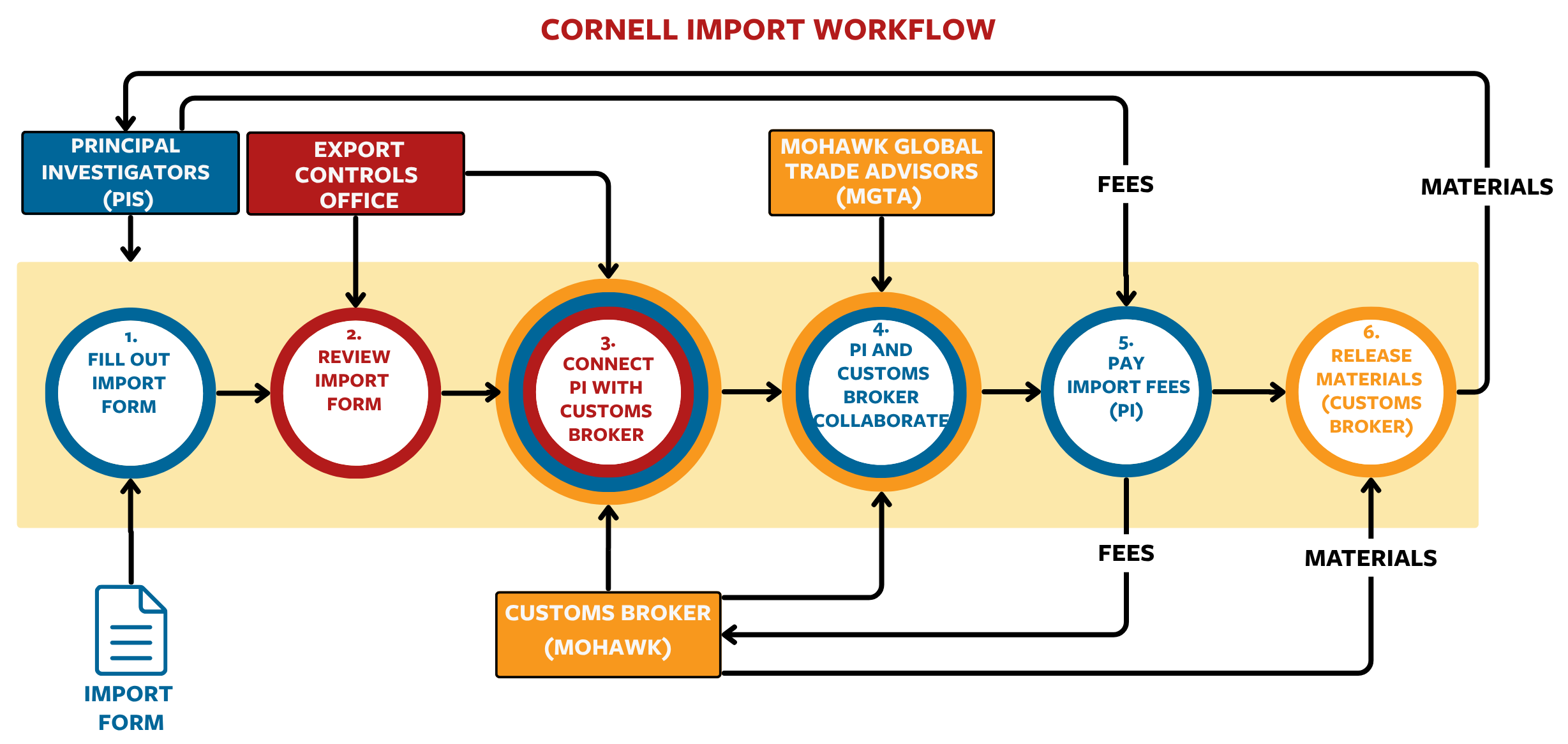
- Fill out import form–Principal Investigators (PIs) fill out the import questionnaire form and email it to exportcontrols@cornell.edu, along with any additional background information.
- Review import form–The Export Controls Office reviews the import form and gives guidance to PIs as necessary.
- Connect PI with customs broker–The Export Controls Office emails the customs broker and introduces the PIs (copied).
PI and customs broker collaborate–PIs send the customs broker any required information and the PIs and customs broker determine the required services and import fees.
Note: Complicated imports (e.g., animals, hazardous materials, etc.) may require the Mohawk Global Trade Advisors (MGTA) consulting group to be involved; MGTA charges $250 an hour.
Pay import fees (PI)–The PIs pay any import fees to the customs broker.
Note: PIs must pay all import fees before any materials can be released to them.
- Release materials (Customs Broker)–The customs broker procures the materials. Once the PIs pay the import fees, the customs broker releases the materials to the PIs.
Partner Government Agencies (PGAs)
Agencies such as the USDA, CDC, USFWS, FDA, etc., also regulate certain goods coming into the U.S. and may impose additional regulatory requirements.
Import of the following items are likely regulated by more than one agency: biological strains and materials, chemicals, geological samples, human specimens, and hazardous materials.
For example:
| Category | Partner Government Agency |
|---|---|
| Animals, animal products, items exposed to animal source materials | USDA-APHIS |
| Plants and plant products | USDA-APHIS |
| Organisms and soils | USDA-APHIS |
| Food, drugs, medical products, cosmetics and tobacco products | FDA |
| Human pathogens, infectious substances, and vectors of human disease | CDC |
| Chemicals | EPA |
| Wildlife, endangered species, marine mammals, and protected birds | US Fish and Wildlife Service |
Note: All items brought onto Cornell’s campus must also meet Environmental, Health and Safety requirements as well as have any necessary internal protocols. See https://ehs.cornell.edu/ and https://researchservices.cornell.edu/compliance for additional details.
Record Retention
Note: Under U.S. Import Regulations, records must be retained for five years after the completion of the activity and made available to the regulating authority upon request. Records that must be retained include all memoranda, notes, correspondence (including email), financial records, shipping documentation, as well as any other information related to the export activities.
Records associated with this policy shall be maintained by the individual or Unit engaging in the activity. Records shall be retained or disposed of in accordance with University Policy 4.7, Retention of University Records.
Contact
Questions? Contact Cornell’s Export Control and Compliance Officer at exportcontrols@cornell.edu.